For Athletic Coaches
Summary: The Eating Disorder Educator-Practitioner credential blends evidence-based clinical knowledge with lived experience and cultural competency, so graduates can recognize eating disorders across all body types, backgrounds, and presentations. Its self-paced, accessible format and flexible pathways, from the full practicum-based credential to an Essentials option with no licensure requirements, make it suitable for clinicians, health educators, family members, and community professionals alike. Better training means fewer missed diagnoses, so health educators who get certified can become providers who see what most others overlook.

about us
Certification and Education for Eating Disorder Health Education
Ninety-two percent of healthcare providers admit they struggle to identify patients with eating disorders.1 That statistic should stop every clinician, educator, and health professional in their tracks. Behind that number are real patients whose symptoms go unrecognized, whose suffering continues because the people meant to help them were never taught what to look for.
This is where eating disorder health education becomes essential rather than optional. For health educators, clinical professionals, and anyone working alongside patients who may be struggling, quality training isn’t a nice-to-have credential to pad a resume. It’s the foundation that determines whether a patient walks out of an appointment with answers or walks out unseen.
The Eating Disorders Education Institute (EDEI) built its certification program specifically to address this gap. Combining evidence-based clinical knowledge with lived experience perspectives, EDEI’s training equips health educators and clinical workers alike with the skills to recognize eating disorders across the full spectrum of bodies, backgrounds, and presentations.
Understanding Eating Disorders Across All Body Types
One of the most persistent and damaging misconceptions in healthcare is the assumption that eating disorders only affect a narrow slice of the population, typically thin, white, affluent women.2 This bias leads directly to missed diagnoses. Eating disorders affect people across all body sizes, genders, racial and ethnic backgrounds, and socioeconomic circumstances. A patient in a larger body can be struggling with restriction just as seriously as a patient in a smaller one, yet clinicians trained to associate eating disorders with visible thinness often overlook the signs entirely.3
This is precisely why cultural competency and body stigma education sits at the center of effective eating disorder health education. Without it, well-meaning providers continue to apply outdated assumptions that exclude entire populations of patients from receiving timely, appropriate care. EDEI’s curriculum directly confronts these misconceptions, training health educators and clinical professionals to recognize eating disorders in patients who don’t fit the stereotype, and to approach every patient interaction with the humility and awareness needed to catch what might otherwise be missed.
What Is the EDEI Certification?

The EDEI certification centers on the Eating Disorder Educator-Practitioner (EDI-EDP) credential, a program designed to serve both clinical workers and members of the general public who want to deepen their understanding of eating disorders. Unlike many certification programs that focus narrowly on clinical protocols, EDEI deliberately blends evidence-based clinical wisdom with the lived experience perspectives of individuals and families who have navigated eating disorders firsthand.
The full credential pathway includes 10 asynchronous courses paired with 24 hours of live group practicum sessions, led by EDEI-trained practitioners. Courses cover foundational topics such as the medical complications of eating disorders, cultural awareness and sensitivity in practice, ethical principles in treatment, and the complex relationship between trauma and disordered eating. Each course is developed and taught by recognized experts in the field, several holding decades of combined clinical and research experience.
This structure allows the certification to meet people wherever they are in their professional journey, whether they’re a licensed clinician seeking to sharpen their diagnostic skills or a health educator working outside a clinical setting who wants to better support the people they serve.
Program Structure and Flexibility
Busy professionals rarely have room in their schedules for rigid, cohort-based training programs. EDEI addresses this by offering self-paced learning and seven different learning pathways, all hosted on the Canvas platform, allowing participants to move through coursework on their own timeline rather than around a fixed class schedule.
Accessibility runs through every part of the program’s design. Content is available in multiple languages, and EDEI offers dyslexia-friendly font options to ensure the curriculum works for learners with different needs. Rather than relying on high-pressure testing formats, the program uses a “confirm understanding” approach instead of traditional quizzes, reflecting EDEI’s broader commitment to humanistic, compassionate education.
This compassionate approach isn’t just a nice philosophical stance. It mirrors the very qualities health educators need to bring into their own work with patients: patience, cultural humility, and a willingness to meet people where they are rather than where a textbook assumes they should be.
Earn Your Badge
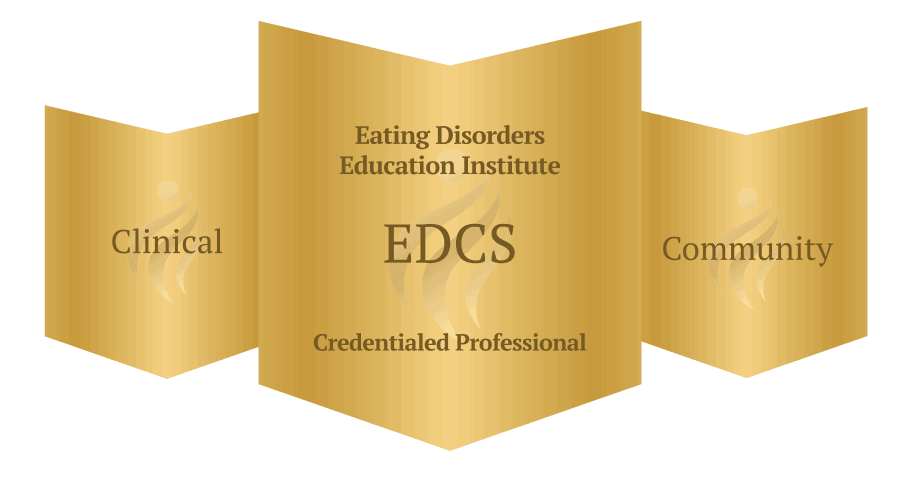
Choose your EDEI Learning Pathway to earn a full EDCS Professional Credential or one of our Certificates. EDEI provides recognizable, portable, uniquely verifiable virtual badges for each program.
Who Should Get Certified in Eating Disorder Health Education
The EDEI certification is built for a wide range of professionals and individuals, including:
- Clinical professionals seeking to improve diagnostic accuracy and catch eating disorders earlier in the course of treatment
- Health educators looking to expand their expertise beyond general wellness topics into the specific, nuanced territory of eating disorder recognition
- Family members and advocates with lived experience who want to better understand and support loved ones navigating recovery
- Anyone committed to reducing eating disorder missed diagnoses, including guidance counselors, athletic coaches, art therapists, and public health professionals
This breadth is intentional. EDEI recognizes that eating disorders don’t only show up in therapy offices. They show up in school hallways, primary care visits, gastroenterology appointments, and conversations with coaches and counselors. Expanding eating disorder health education beyond specialists is one of the most direct ways to close the 92% diagnostic gap.
How EDEI Supports Your Practice
Health educators who complete the EDEI certification walk away with more than a credential to list on a résumé. The program is designed to translate directly into day-to-day practice.
Participants gain evidence-based training grounded in clinical research, combined with real-world insights from practitioners who have spent years working directly with eating disorder patients. The cultural competency components prepare health educators to work effectively with diverse patient populations, reducing the likelihood that a patient’s symptoms get dismissed or misread because they don’t match outdated assumptions.
Perhaps most importantly, the certification equips health educators with practical tools to recognize eating disorders across the full spectrum of bodies, ages, and backgrounds. This is the kind of knowledge that gets applied immediately, in the next patient conversation, the next classroom discussion, the next community health initiative.
Getting Started with EDEI
EDEI structures our certification pathways to accommodate different starting points. The full EDCS pathway includes a practicum component, while EDCS Direct is designed for those who already hold qualifying credentials like CEDS and does not require the practicum. An Essentials pathway is also available for those without a license, graduate degree, or clinical hours, and individual courses can be taken on their own. Equity pricing is available for those who need it.
Prerequisites vary by pathway. The full EDCS credential requires licensure, a graduate degree, and 1,000 direct clinical hours, while the Essentials pathway has no licensure, degree, or experience requirements at all, making it accessible to health educators and community members without a clinical background. Those who already hold a CEDS credential can transfer their standing through June 2027.
Enrollment information and upcoming cohort dates for the live practicum sessions are available directly through EDEI, and support resources are available throughout the certification journey to help participants stay on track, regardless of their starting point or professional background.
Closing the Gap Starts with Education
The EDEI certification offers health educators and clinical professionals a structured, flexible, and compassionate path toward that goal. Whether you’re a clinician refining your diagnostic instincts or a health educator looking to expand what you can offer the people you serve, this training provides the tools to recognize what might otherwise be missed.
The gap in education has created a gap in care. Closing it starts with the decision to get trained. Explore the EDEI certification pathways today and take the next step toward becoming a provider who sees what 92% of others miss.
References
- Linville, D., Brown, T., & O’Neil, M. (2011). Medical providers” self perceived knowledge and skills for working with eating disorders: A national survey. Eating Disorders, 20(1), 1–13. https://doi.org/10.1080/10640266.2012.635557
- Frequently asked eating disorders questions from Students-NEDA. (2024, January 11). National Eating Disorders Association. https://www.nationaleatingdisorders.org/frequently-asked-questions-from-students/
- Alexander, T., Burnette, C. B., Cory, H., McHale, S., & Simone, M. (2024). The need for more inclusive measurement to advance equity in eating disorders prevention. Eating Disorders, 32(6), 798–816. https://doi.org/10.1080/10640266.2024.2328460
Hear From EDEI contemporaries
What I want to say to anybody who's entering this field is use your voice…because you never know the lives, the moments, the people, the memories that you're going to save by doing so.
EDEI is meaningful to me because it honors the stories, struggles, and resilience of everyone affected by eating disorders. Its education rooted in lived experience, evidence, wisdom and care.
When I first began developing “Foundations of Cultural Awareness and Sensitivity in Eating Disorder Practice, Research, and Advocacy,” my vision was…to cultivate an experience that opens doors for learners to reflect deeply, challenge assumptions, and grow into more culturally aware, sensitive, and responsive providers.
We all want to see our clients recover, and we must guide them in that direction taking into account their autonomy as well as our responsibilities as clinicians to protect.
about us
Sign Up For Information
Explore our website and learn more about how our courses can increase your knowledge, improve your care, and work toward a world that can better understand and treat eating disorders. EDEI delivers global learning, with courses that build knowledge and understanding, increase confidence, impact care.



12+ Courses Offered