For Athletic Coaches
Summary: Athletic coaches spend more time with athletes than almost anyone else, which puts them in a unique position to spot early signs of an eating disorder, yet most have never been trained to recognize or respond to them. Eating disorders often hide in athletic settings, where restriction and overtraining can be mistaken for discipline and dedication. The Eating Disorders Education Institute (EDEI) offers self-paced, evidence-based certification programs that teach coaches to identify warning signs, hold supportive conversations, maintain professional boundaries, and connect athletes with the right resources. Pathways range from the Essentials certificate, which has no prerequisites, to the full EDCS credential with a live practicum, helping coaches build confidence and put athlete wellbeing first.

about us
Certification and Education For Coaches Dealing With Eating Disorders in Athletes
Athletic coaches spend more hours with their athletes than almost anyone else in their lives—more than a family doctor, more than a school counselor, sometimes more than parents during competitive seasons. That proximity gives coaches a front-row seat to changes in behavior, mood, and physical condition that can signal an eating disorder long before anyone else notices. Yet most coaches dealing with eating disorders in athletes have never received formal training on how to recognize warning signs or respond appropriately when they see them.
This is precisely the gap the Eating Disorders Education Institute (EDEI) was built to close. EDEI offers specialized, evidence-based certification programs developed by eating disorder experts and adult learning specialists, designed to give coaches and other professionals the knowledge and confidence to intervene early and support athletes responsibly.
What Is an Eating Disorder?
Eating disorders are serious mental health conditions characterized by persistent disturbances in eating behaviors, accompanied by distressing thoughts and emotions about food, weight, or body shape. Common types include anorexia nervosa, bulimia nervosa, binge eating disorder, and other specified feeding or eating disorders (OSFED).1
In athletic populations, these conditions often manifest differently than they do in the general public. An athlete restricting calories might be framed—by themselves, their teammates, or even coaches—as simply “disciplined” or “focused on performance.” Overtraining can mask compulsive exercise patterns.2 Weight-class sports, aesthetic sports like gymnastics and figure skating, and endurance sports can all create cultures where disordered eating hides in plain sight, disguised as dedication to the craft. This makes early detection harder, and it makes trained observation even more essential.3
Why Coaches Dealing with Eating Disorders in Athletes Need EDEI Certification

Coaches are frequently the first adults to notice warning signs in athletes: sudden weight changes, rigid food rules, anxiety around team meals, or a drop in energy and performance that doesn’t match training load. Without specialized training, coaches dealing with eating disorders in athletes may miss these cues entirely, misread them as motivation issues, or feel unprepared to say anything at all.
That hesitation has real consequences. According to research, 92% of surveyed frontline medical providers—including general practice physicians and nurse practitioners—believed they had missed at least one eating disorder diagnosis in their clinical work.4 If trained medical professionals struggle with this, it’s reasonable to expect coaches face the same challenge, often without any clinical background to fall back on.
EDEI Certification equips coaches with evidence-based knowledge and practical tools to close that gap. Rather than guessing at the right thing to say or waiting for a crisis to force action, certified coaches learn how to recognize risk factors early, open supportive conversations, and connect athletes with appropriate professional resources—all while staying within the appropriate boundaries of their coaching role.
The EDEI Certification Program Overview
EDEI’s courses are hosted on the Canvas platform and taught by a faculty of more than 15 qualified eating disorder instructors, many holding credentials such as PhD, MD, LMFT, and CEDS-C. The curriculum draws from a Delphi-validated needs assessment that identified 157 priority competencies in eating disorder care, combining input from instructors with a combined 300+ years of clinical experience.
Courses are self-paced, accessible on desktop or mobile, and built with accessibility in mind—including a dyslexia-friendly font and translation into more than 40 languages. Instead of traditional tests or quizzes, EDEI uses a “Confirm Understanding” model to check comprehension as learners move through the material.
For coaches pursuing the full EDCS (Eating Disorders Certified Specialist) credential, the pathway includes core coursework alongside 18 hours of live group practicum—twelve 90-minute sessions in small groups of 4 to 6, working through real case material with a trained consultant. Coaches who already hold a relevant credential may be eligible for EDCS Direct, which includes the same core courses without the practicum requirement.
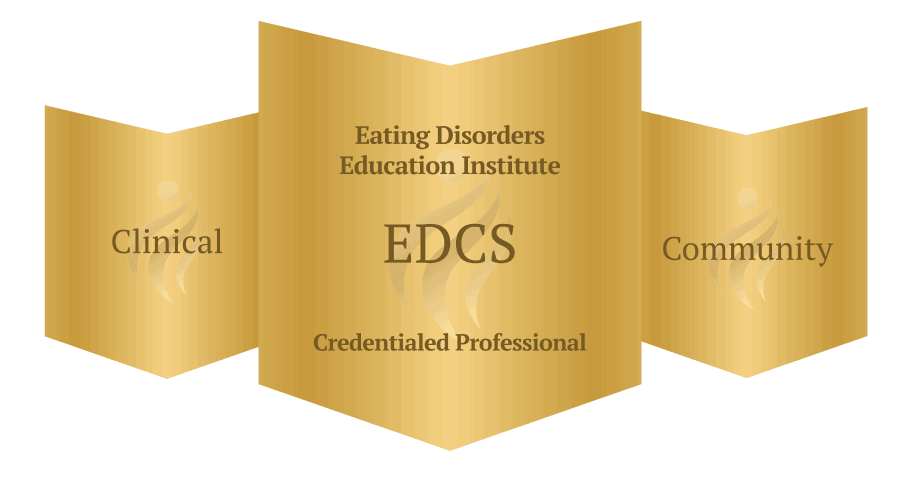
Earn Your Badge
Choose your EDEI Learning Pathway to earn a full EDCS Professional Credential or one of our Certificates. EDEI provides recognizable, portable, uniquely verifiable virtual badges for each program.
What You'll Learn in EDEI Certification
The curriculum is built around the practical realities coaches face day to day. Key areas include:
- Recognizing early warning signs and risk factors, including how disordered eating patterns present differently in athletes compared to the general population
- Communication strategies for approaching sensitive conversations with athletes without causing shame or defensiveness
- Maintaining appropriate boundaries while still offering meaningful support—understanding where a coach’s role ends and a clinician’s role begins
- Resources and referral pathways to mental health professionals, dietitians, and medical providers equipped to treat eating disorders
- Building a healthier team culture, one that reduces stigma around food and body image and makes it easier for athletes to speak up before a problem escalates
Each of these areas reflects EDEI’s broader commitment to weight-inclusive, culturally responsive care—recognizing that eating disorders affect athletes across all body sizes, identities, and sports.
How EDEI Certification Supports Your Coaching Practice
Certification isn’t just a credential to list on a resume. It gives coaches dealing with eating disorders in athletes practical frameworks they can apply immediately—scripts for difficult conversations, criteria for when to escalate a concern, and a clearer sense of their own role in an athlete’s broader care team.
That clarity builds confidence. Coaches who understand the warning signs and know how to respond are far less likely to freeze up or avoid the topic altogether when something feels off. This protects athlete health, certainly, but it also protects the integrity and reputation of a coaching program. Teams and organizations that take eating disorder education seriously send a clear signal to athletes, parents, and administrators that athlete wellbeing comes first, not just performance outcomes.
Getting Started with EDEI Certification
EDEI’s pathways are built with flexibility in mind. The Essentials certificate has no licensure, degree, or experience requirements, making it accessible to coaches without a clinical background who still want foundational knowledge. The full EDCS pathway, which includes the practicum, is designed for those with more direct clinical or athlete-facing experience, though coaches are increasingly recognized as a vital part of the broader eating disorder care community.
Equip Yourself to Support the Athletes You Coach
Athletes trust their coaches with more than technique and strategy—they trust them to notice when something is wrong. Specialized training through EDEI gives coaches dealing with eating disorders in athletes the knowledge, language, and confidence to meet that trust with informed, compassionate action.
If you’re ready to strengthen your ability to recognize and respond to eating disorders on your team, explore EDEI’s certification pathways and take the next step toward safer, more supportive coaching.
References
- Guarda, A. (2023). What are eating disorders? American Psychiatric Association. https://www.psychiatry.org/patients-families/eating-disorders/what-are-eating-disorders
- Mountjoy, M., Ackerman, K. E., Bailey, D. M., Burke, L. M., Constantini, N., Hackney, A. C., Heikura, I. A., Melin, A., Pensgaard, A. M., Stellingwerff, T., Sundgot-Borgen, J. K., Torstveit, M. K., Jacobsen, A. U., Verhagen, E., Budgett, R., Engebretsen, L., & Erdener, U. (2023). 2023 International olympic committee’s (IOC) consensus statement on relative energy deficiency in sport (REDs). British Journal of Sports Medicine, 57(17), 1073–1097. https://doi.org/10.1136/bjsports-2023-106994
- Wells, K. R., Jeacocke, N. A., Appaneal, R., Smith, H. D, Vlahovich, N., Burke, L. M., & Hughes, D. (2020). The Australian Institute of Sport (AIS) and national eating disorders collaboration (NEDC) position statement on disordered eating in high performance sport. British Journal of Sports Medicine, 54(21), 1247–1258. https://doi.org/10.1136/bjsports-2019-101813
- Mills, R., Hyam, L., & Schmidt, U. (2023). A narrative review of early intervention for eating disorders: Barriers and facilitators. Adolescent Health, Medicine and Therapeutics, Volume 14(14), 217–235. https://doi.org/10.2147/ahmt.s415698
Hear From EDEI contemporaries
What I want to say to anybody who's entering this field is use your voice…because you never know the lives, the moments, the people, the memories that you're going to save by doing so.
EDEI is meaningful to me because it honors the stories, struggles, and resilience of everyone affected by eating disorders. Its education rooted in lived experience, evidence, wisdom and care.
When I first began developing “Foundations of Cultural Awareness and Sensitivity in Eating Disorder Practice, Research, and Advocacy,” my vision was…to cultivate an experience that opens doors for learners to reflect deeply, challenge assumptions, and grow into more culturally aware, sensitive, and responsive providers.
We all want to see our clients recover, and we must guide them in that direction taking into account their autonomy as well as our responsibilities as clinicians to protect.
about us
Sign Up For Information
Explore our website and learn more about how our courses can increase your knowledge, improve your care, and work toward a world that can better understand and treat eating disorders. EDEI delivers global learning, with courses that build knowledge and understanding, increase confidence, impact care.



12+ Courses Offered