For Gastroenterologists
Gastroenterologists are often the first clinicians to spot the warning signs of an eating disorder, yet most receive little formal training in this area. EDEI Certification from The Eating Disorders Institute equips a gastroenterologist specializing in eating disorders with evidence-based clinical protocols, cultural competency training, and ongoing education to close this critical care gap.

about us
Certification and Education for Eating Disorders For Gastroenterologists
Gastroenterologists occupy a unique position in eating disorder care. Patients rarely walk into a GI clinic and announce they’re struggling with anorexia, bulimia, or binge eating disorder. Instead, they present with gastroparesis, chronic reflux, unexplained weight changes, or persistent abdominal pain—symptoms that can mask an underlying eating disorder for months or years. Recognizing these patterns requires more than general medical training; it demands specialized knowledge that most gastroenterology programs simply don’t provide.
That’s where certification comes in. A gastroenterologist specializing in eating disorders needs training that goes beyond standard GI education, combining evidence-based clinical wisdom with the compassionate, patient-centered approach that eating disorder care demands. This is precisely the gap that EDEI Certification was designed to fill.
Our specialized eating disorder training allows Gastroenterologists to gain the knowledge and skills necessary to effectively and ethically treat patients with eating disorders. It also allows for compassionate and patient-centered care, as well as the ability to collaborate with other healthcare professionals in a multidisciplinary team approach.
The Intersection Between Gastroenterology and Eating Disorders
Eating disorders don’t discriminate by body size, age, gender, or background. A person in any sized body can be suffering from a serious eating disorder, and Gastroenterologists who assume otherwise risk missing critical diagnoses. This body image misconception remains one of the biggest barriers to early identification of eating disorders in clinical settings.1
Instead of relying on outdated body image stereotypes, a gastroenterologist specializing in eating disorders must be aware of the complications and symptoms that often accompany these disorders. These can include gastrointestinal issues such as nausea, vomiting, abdominal pain, and constipation or diarrhea.
Common GI Complications Linked to Eating Disorders
Several gastrointestinal conditions frequently accompany eating disorders, including:
- Gastroparesis — delayed stomach emptying often seen in restrictive eating patterns2
- Chronic reflux — frequently tied to purging behaviors or disordered eating cycles3
- Malnutrition-related complications — including electrolyte imbalances and digestive dysfunction4
Because these symptoms overlap with countless other GI conditions, Gastroenterologists are frequently the first medical professionals to observe warning signs before a formal eating disorder diagnosis is ever made.
Why EDEI Certification Matters for a Gastroenterologist Specializing in Eating Disorders

Standard gastroenterology training rarely includes dedicated coursework on eating disorder identification or treatment collaboration. EDEI Certification bridges the divide between gastrointestinal care and mental health treatment, giving clinicians a shared language and framework to work alongside psychologists, dietitians, and psychiatrists.
For a gastroenterologist specializing in eating disorders, our certification provides:
- A structured way to recognize subtle warning signs earlier in the disease course
- Confidence in referring patients to appropriate mental health and nutrition support
- Assurance that their clinical knowledge reflects current, evolving industry standards
- A demonstrated commitment to humanistic, culturally competent care across all body types
The Eating Disorders Education Institute continuously assesses where the field stands, using the latest eating disorders statistics and research to influence our courses. By doing so, we are ensuring our certification and coursework evolve alongside emerging research rather than becoming outdated.
What an EDEI Certification Covers
The EDEI curriculum blends clinical depth with practical, real-world application. Core components include:
- Comprehensive clinical assessment and diagnostic protocols tailored to gastroenterology settings
- Evidence-based treatment approaches for eating disorders across the diagnostic spectrum
- Cultural competency training that reflects the full diversity of body types and patient backgrounds
- Micro-certifications for specialized focus areas, such as adolescent eating disorders
- Access to the CANVAS platform, which offers multiple language options and dyslexia-friendly resources for accessible learning
The program’s structure allows clinicians to move through ten asynchronous courses at their own pace, with topics five through ten paired with live, practitioner-led practicum sessions. Completing the full 10 courses alongside 24 hours of live group practicum earns clinicians the EDI-EDP Credential.
How EDEI Certification Enhances Your Practice
Certification isn’t just a credential to display—it changes how clinicians practice day to day. Choose EDEI Certification if improving diagnostic accuracy and building stronger interdisciplinary relationships matter more to your practice than a general continuing education credit.
Certified clinicians can benefit from:
- Earlier identification of eating disorders, often before severe medical complications develop
- Stronger collaboration with mental health providers, dietitians, and therapists
- Improved patient trust, particularly among patients who fear judgment about their body or eating habits
- Greater recognition as a trusted gastroenterologist specializing in eating disorders within their professional community
These outcomes matter both for patient health and for the long-term credibility of a gastroenterology practice that wants to be known for comprehensive, compassionate care.
Getting Certified
The Eating Disorders Education Institute designed our certification pathway to accommodate different professional roles and levels of clinical involvement:
- Clinical workers who see patients directly can engage with both the curriculum and live practicum sessions.
- Mental health professionals with a master’s degree can access the coursework, though not the practicum track.
- General practitioners, educators, and community leaders can pursue foundational courses to build awareness, even without direct clinical involvement in eating disorder treatment.
Courses are self-paced and led by practicing experts, with “Confirm Understanding” checkpoints replacing traditional tests or quizzes. This structure respects busy clinical schedules while still ensuring comprehension. EDEI also honors existing certifications: clinicians already holding or pursuing a recognized credential can have that investment transferred into the EDEI pathway, though this option will no longer be available after June 2027.
Beyond clinical certification, The Eating Disorders Institute recognizes that families and individuals affected by eating disorders also need accessible education. Our organization’s broader mission includes supporting non-clinical learners who want to better understand eating disorders alongside the professionals treating them.
Earn Your Badge
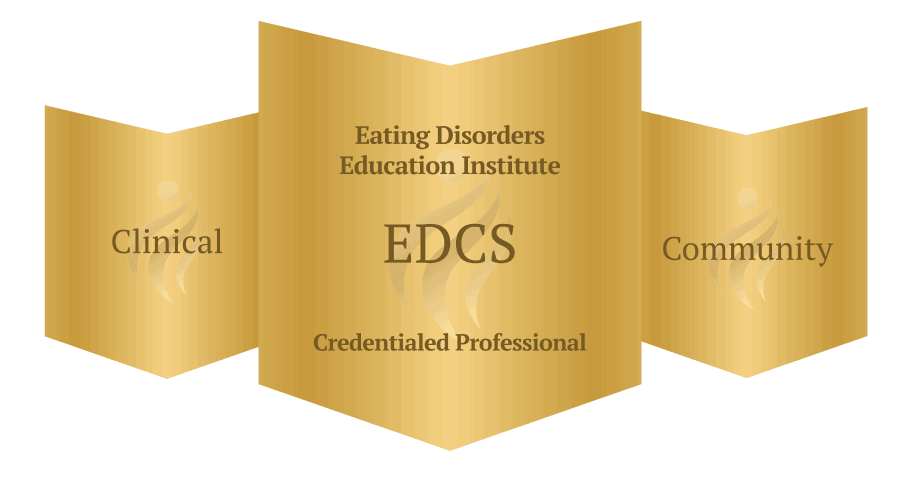
Choose your EDEI Learning Pathway to earn a full EDCS Professional Credential or one of our Certificates. EDEI provides recognizable, portable, uniquely verifiable virtual badges for each program.
Leading the Way in Compassionate, Evidence-Based Care
Eating disorders remain widely underdiagnosed, and Gastroenterologists sit at a critical intersection where early identification can change a patient’s entire treatment trajectory. Specialized training isn’t an optional add-on anymore; it’s becoming a professional expectation as the field continues to evolve.
EDEI Certification offers a structured, evidence-based path for any clinician ready to close the education gap and provide the kind of humanistic, culturally competent care that eating disorder patients deserve. Explore certification pathways through The Eating Disorders Education Institute and take the next step toward becoming a recognized leader in eating disorder-informed gastroenterology.
Frequently Asked Questions
Who should pursue EDEI Certification?
How long does it take to complete the certification?
Do I need a clinical background to enroll?
What if I already hold a different eating disorder certification?
Is the coursework accessible for non-native English speakers or those with learning differences?
References
- Bryant, E., Spielman, K., Le, A., Marks, P., Aouad, P., Barakat, S., Boakes, R., Brennan, L., Bryant, E., Byrne, S., Caldwell, B., Calvert, S., Carroll, B., Castle, D., Caterson, I., Chelius, B., Chiem, L., Clarke, S., Conti, J., … Maguire, S. (2022). Screening, assessment and diagnosis in the eating disorders: Findings from a rapid review. Journal of Eating Disorders, 10(1). https://doi.org/10.1186/s40337-022-00597-8
- Cleveland Clinic. (2018). Gastroparesis. Cleveland Clinic. https://my.clevelandclinic.org/health/diseases/15522-gastroparesis
- Giel, K. E., Bulik, C. M., Fernandez-Aranda, F., Hay, P., Keski-Rahkonen, A., Schag, K., Schmidt, U., & Zipfel, S. (2022). Binge eating disorder. Nature Reviews Disease Primers, 8(1). https://doi.org/10.1038/s41572-022-00344-y
- Saunders, J., & Smith, T. (2010). Malnutrition: Causes and consequences. Clinical Medicine, 10(6), 624–627. https://doi.org/10.7861/clinmedicine.10-6-624
Hear From EDEI contemporaries
What I want to say to anybody who's entering this field is use your voice…because you never know the lives, the moments, the people, the memories that you're going to save by doing so.
EDEI is meaningful to me because it honors the stories, struggles, and resilience of everyone affected by eating disorders. Its education rooted in lived experience, evidence, wisdom and care.
When I first began developing “Foundations of Cultural Awareness and Sensitivity in Eating Disorder Practice, Research, and Advocacy,” my vision was…to cultivate an experience that opens doors for learners to reflect deeply, challenge assumptions, and grow into more culturally aware, sensitive, and responsive providers.
We all want to see our clients recover, and we must guide them in that direction taking into account their autonomy as well as our responsibilities as clinicians to protect.
about us
Sign Up For Information
Explore our website and learn more about how our courses can increase your knowledge, improve your care, and work toward a world that can better understand and treat eating disorders. EDEI delivers global learning, with courses that build knowledge and understanding, increase confidence, impact care.



12+ Courses Offered