For Endocrinologists
Endocrinologist eating disorders training equips hormone specialists to recognize disordered eating that mimics or masks metabolic conditions. The Eating Disorders Institute’s EDEI Certification combines clinical evidence with lived experience, teaching endocrinologists to identify warning signs, apply trauma-informed care, and serve patients across all body sizes—closing a critical gap that currently causes 92% of providers to miss eating disorder symptoms in their patients.

about us
Certification and Education for Eating Disorders For Endocrinologists
Endocrinologists sit at a unique crossroads of patient care. Thyroid disorders, diabetes, PCOS, and metabolic syndrome all bring patients through their doors—and many of these same conditions overlap with, mask, or are worsened by eating disorders. Yet most endocrinology training programs spend little to no time teaching clinicians how to spot the signs. That gap matters. Many providers admit to missing patients with eating disorders, meaning countless individuals go undiagnosed while their underlying hormonal and metabolic issues are treated in isolation.
This is where specialized endocrinologist eating disorders training becomes essential rather than optional. When endocrinologists understand how disordered eating manifests in their specific patient population, they catch problems earlier, refer more effectively, and provide care that treats the whole patient—not just the lab values. At Eating Disorders Education Institute (EDEI), our certification program equips endocrinologists with the knowledge, tools and resources to effectively address eating disorders in their practice.
Understanding Eating Disorders in Endocrine Practice
Eating disorders don’t exist in a vacuum. They interact directly with metabolic health and endocrine function, often in ways that complicate diagnosis. Restrictive eating can suppress thyroid hormone production.1 Binge eating patterns can worsen insulin resistance.2 Purging behaviors can throw off electrolyte balance in ways that mimic other endocrine conditions entirely.3
The connection runs both directions. Hormonal imbalances can trigger or intensify disordered eating behaviors, while disordered eating can create hormonal chaos that brings patients to an endocrinologist’s office in the first place.4 In practice, this means a patient may present with symptoms that point in multiple directions at once, including:
- Irregular menstrual cycles that could signal a primary endocrine disorder, an eating disorder, or both
- Unexplained weight fluctuations that don’t fit a clear hormonal or metabolic pattern
- Persistent fatigue that overlaps with thyroid dysfunction, adrenal issues, and nutritional deficiencies tied to restrictive eating
More often than clinicians realize, these presentations aren’t either/or — they’re both simultaneously.
This overlap puts endocrinologists in a distinctive position. Endocrinologist eating disorders training programs allow providers to see patients regularly, order detailed lab work, and track long-term metabolic trends while relating that information to a person’s disease. Few other specialists have this level of visibility into the physical patterns that eating disorders leave behind. The challenge is knowing what to look for and having the confidence to address it directly with patients.
What Is an EDEI Certification?

Our EDEI Certification is an evidence-based training program developed by The Eating Disorders Education Institute to encourage providers in all specialties to incorporate eating disorders prevention, identification, and treatment into their practices. Rather than treating eating disorder education as a niche specialty, EDEI built our certification to reflect how clinical wisdom and lived experience work best together.
Our program blends research-backed protocols with insights from people who have personally navigated eating disorders and recovery. This combination gives clinicians both the diagnostic framework and the human context needed to recognize disordered eating in real patients, not just textbook presentations.
A central pillar of our certification is cultural competency. EDEI’s approach is built on the understanding that eating disorders affect people in bodies of every size, background, and identity. This matters enormously in endocrinology, where assumptions about weight and metabolic health can sometimes obscure rather than clarify what’s actually happening with a patient.5
Our certification pathway includes 10 asynchronous courses paired with 24 hours of live group practicum, led by EDEI-trained practitioners. Participants move through six courses independently before topics five through ten introduce live three-hour practicum sessions. Completing this full sequence earns the EDI-EDP Credential.
Key Benefits of EDEI Certification for Endocrinologists
Specialized training in endocrinologist eating disorders identification delivers benefits that extend well beyond a certificate on the wall. These include:
Enhanced diagnostic skills
Endocrinologists trained through EDEI Certification learn to recognize subtle warning signs—patterns in lab results, behavioral cues, and patient history—that often go unnoticed in a standard appointment.
Improved patient outcomes
When clinicians catch disordered eating early and respond with compassion rather than judgment, patients are more likely to engage in treatment and see better long-term health results.
Evidence-based protocols
Rather than relying on outdated assumptions, certified endocrinologists gain access to current, research-backed frameworks for assessment and intervention.
Continuing education and professional growth
The certification also supports ongoing professional development, giving endocrinologists a credential that reflects specialized, in-demand expertise.
EDEI’s certification ensures endocrinologists are equipped with the latest knowledge, compassionate practices, and professional tools to provide exceptional, patient-centered care while advancing their careers.
What Does the EDEI Curriculum Actually Cover?
Our curriculum is built to be thorough without being overwhelming. Course content covers comprehensive eating disorder assessment and intervention strategies, giving endocrinologists practical tools they can apply immediately in clinical settings.
Several courses focus specifically on clinical frameworks for identifying and addressing endocrinologist eating disorders scenarios—cases where hormonal and metabolic symptoms overlap with or disguise disordered eating behaviors. This isn’t generic eating disorder education; it’s built around the specific situations endocrinologists actually encounter.
Our program also emphasizes humanistic and trauma-informed approaches to patient care. Instead of standard tests or quizzes, EDEI uses a “Confirm Understanding” model to check comprehension, reflecting our program’s broader philosophy of compassionate, non-punitive learning.
Accessibility is built into the design as well. Our catalog of course materials are available in multiple languages and in dyslexia-friendly formats, delivered through the Canvas learning platform. Clinicians can work through content at their own pace, fitting the coursework around demanding clinical schedules.
Earn Your Badge
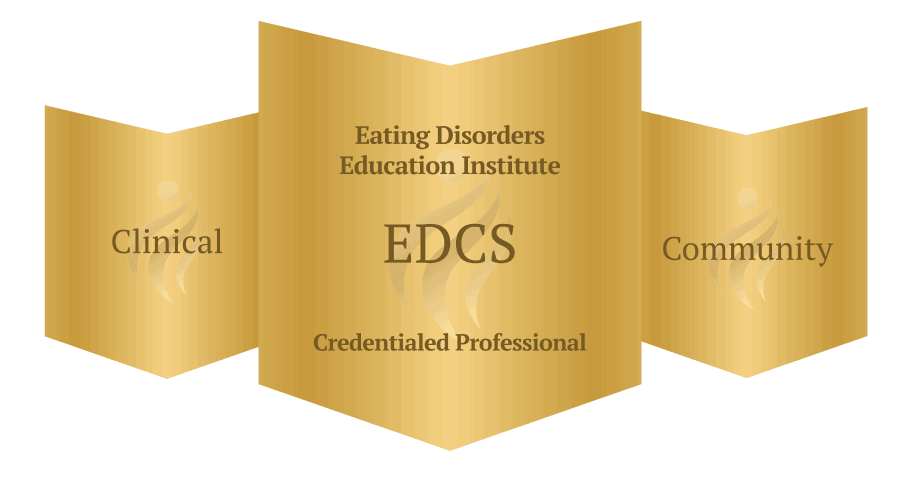
Choose your EDEI Learning Pathway to earn a full EDCS Professional Credential or one of our Certificates. EDEI provides recognizable, portable, uniquely verifiable virtual badges for each program.
Why Does Cultural Competency Matter in Eating Disorder Care?
One of the most important lessons EDEI Certification teaches is that eating disorders don’t look the same in every patient. Someone in a larger body can have a severe eating disorder that goes unrecognized simply because their weight doesn’t match outdated stereotypes. Someone in a smaller body may be assumed to be healthy when they’re actually struggling significantly.
Cultural background also shapes how eating disorders present and how patients talk about their symptoms. A clinician trained to recognize only the most stereotypical presentations will miss patients who don’t fit that narrow picture.
EDEI Certification builds confidence and knowledge specifically around this diversity, helping endocrinologists serve patients from all backgrounds and body types without relying on assumptions that could lead to missed diagnoses.
How Do Endocrinologists Get Started with EDEI Certification?
Getting started is straightforward. Clinical workers who see patients directly can engage with both the curriculum and the live practicum component. Those holding CEDS credentials can participate through the IADEP pathway. Mental health professionals with a master’s degree can access the coursework, though not the practicum portion, while other community members, such as guidance counselors or health educators, can pursue foundational, non-clinical education.
For those already holding a related certificate, EDEI has structured the program to honor that investment through a transfer pathway rather than requiring participants to start from zero. Enrollment resources and ongoing support are available directly through The Eating Disorders Institute for clinicians ready to begin their certification journey.
Investing in Endocrinologist Eating Disorders Expertise Pays Off
The overlap between endocrine health and eating disorders isn’t going away, and the cost of missing it is high. Every undiagnosed case represents a patient whose care plan is incomplete, no matter how precise the lab work or how well-managed their hormone levels appear on paper.
EDEI Certification offers endocrinologists a clear, structured pathway to close this gap. By combining clinical evidence, lived experience, and cultural competency, the program equips clinicians to see patients more fully and treat them more effectively. For any endocrinologist committed to comprehensive, compassionate care, this specialized training isn’t a side credential. It’s becoming foundational to the practice itself.
Frequently Asked Questions
Who is eligible for EDEI Certification?
How long does the certification take to complete?
What if I already hold a related certification, like CEDS?
What makes EDEI Certification different from other eating disorder training programs?
What if I already hold a related certification, like CEDS?
References
- Usdan, L., Khaodhiar, L., & Apovian, C. (2008). The endocrinopathies of anorexia nervosa. Endocrine Practice, 14(8), 1055–1063. https://doi.org/10.4158/ep.14.8.1055
- Parry, S., Woods, R., Hodson, L., & Hulston, C. (2017). A single day of excessive dietary fat intake reduces whole-body insulin sensitivity: The metabolic consequence of binge eating. Nutrients, 9(8), 818. https://doi.org/10.3390/nu9080818
- Mehler, P. S., & Walsh, K. (2016). Electrolyte and acid‐base abnormalities associated with purging behaviors. International Journal of Eating Disorders, 49(3), 311–318. https://doi.org/10.1002/eat.22503
- Culbert, K. M., Racine, S. E., & Klump, K. L. (2016). Hormonal factors and disturbances in eating disorders. Current Psychiatry Reports, 18(7). https://doi.org/10.1007/s11920-016-0701-6
- Tomiyama, A. J., Carr, D., Granberg, E. M., Major, B., Robinson, E., Sutin, A. R., & Brewis, A. (2018). How and why weight stigma drives the obesity ‘epidemic’ and harms health. BMC Medicine, 16(1). https://doi.org/10.1186/s12916-018-1116-5
Hear From EDEI contemporaries
What I want to say to anybody who's entering this field is use your voice…because you never know the lives, the moments, the people, the memories that you're going to save by doing so.
EDEI is meaningful to me because it honors the stories, struggles, and resilience of everyone affected by eating disorders. Its education rooted in lived experience, evidence, wisdom and care.
When I first began developing “Foundations of Cultural Awareness and Sensitivity in Eating Disorder Practice, Research, and Advocacy,” my vision was…to cultivate an experience that opens doors for learners to reflect deeply, challenge assumptions, and grow into more culturally aware, sensitive, and responsive providers.
We all want to see our clients recover, and we must guide them in that direction taking into account their autonomy as well as our responsibilities as clinicians to protect.
about us
Sign Up For Information
Explore our website and learn more about how our courses can increase your knowledge, improve your care, and work toward a world that can better understand and treat eating disorders. EDEI delivers global learning, with courses that build knowledge and understanding, increase confidence, impact care.



12+ Courses Offered