For Peer Support Specialists
The EDEI Certification equips Peer Support Specialists with evidence-based knowledge and lived-experience insight to support people recovering from eating disorders. Offered by The Eating Disorders Education Institute (EDEI), the program blends asynchronous coursework with live practicum hours, serves both clinical workers and the general public, and is designed to close a well-documented gap in eating disorder care.

about us
Certification and Education for Eating Disorders Peer Support Specialists
Eating disorder peer support is one of the most underutilized resources in recovery, even though it offers something clinical treatment alone cannot: the perspective of someone who has lived through it. Peer Support Specialists bring empathy, credibility, and hope to people navigating one of the most isolating mental health struggles that exists. But showing up with good intentions isn’t enough. Peer supporters need structured training that reflects current science, honors lived experience, and prepares them for the real complexity of eating disorders.
That’s where the EDEI Certification comes in. Created by The Eating Disorders Education Institute (EDEI), this certification was built specifically to train Peer Support Specialists, alongside clinicians, educators, and advocates, in evidence-based and culturally competent care.
It’s also worth saying plainly: eating disorders affect people in bodies of every size, shape, gender, and background. Recovery support that assumes otherwise leaves too many people without the help they need.
Why Peer Support Matters in Eating Disorder Recovery
Lived experience carries a kind of authority that clinical training alone can’t replicate. When a Peer Support Specialist has personally navigated disordered eating and recovery, they can offer validation and hope in ways that feel immediate and real to the person in front of them. This doesn’t replace clinical treatment, it strengthens it.1
Peer support typically works alongside therapists, dietitians, and medical providers, filling in the gaps between appointments with ongoing encouragement, accountability, and connection. Peer Support Specialists, when properly trained, help close often large treatment gaps by recognizing warning signs, offering informed support, and connecting people to appropriate resources faster.
As awareness of eating disorders grows across schools, athletic programs, workplaces, and healthcare systems, so does the demand for trained eating disorder peer support specialists who can meet people where they are.
Understanding Eating Disorders Across Diverse Populations

Eating disorders don’t follow a single script. They show up differently depending on culture, body type, gender identity, age, and access to care.2 A Peer Support Specialist trained to recognize only the most stereotypical presentation of an eating disorder will miss the majority of people who need help.
Effective training must address this directly. Cultural competency means understanding how disordered eating manifests across different communities and avoiding assumptions based on appearance alone. It means recognizing that all of the following people can struggle just as seriously as anyone else:
- Someone in a larger body
- A man
- An older adult
- A person from a marginalized community
Often, they face additional barriers to being believed or diagnosed. Recovery, too, looks different for everyone. There’s no single timeline or definition of “better.” Peer Support Specialists trained with this nuance through stigma education are better equipped to meet each person’s recovery on its own terms, rather than measuring it against a narrow standard.
The EDEI Certification: What It Offers
The EDEI Certification curriculum was built to blend two things that are often kept separate: clinical, evidence-based knowledge and the wisdom that comes from lived experience. Both matter, and EDEI’s program treats them as complementary rather than competing sources of expertise.
The certification path includes 10 asynchronous courses paired with 24 hours of live group practicum, led by EDEI-trained practitioners, culminating in the EDI-EDP Credential. Learners move through the first four courses independently, then join live, three-hour practicum sessions for topics five through ten, applying what they’ve learned in real time with guidance from experienced facilitators. Rather than traditional tests, the program uses a “Confirm Understanding” approach to check comprehension, which keeps the focus on genuine learning rather than rote memorization.
Importantly, the EDEI Certification isn’t limited to one type of learner. It’s open to a wide range of people, including:
- Clinical workers
- Mental health professionals with a Master’s degree
- Guidance counselors
- Community leaders
- Aspiring Peer Support Specialists who may not come from a clinical background
For those already holding or pursuing other eating disorder certifications, EDI has committed to honoring that existing investment through a transfer policy, with full transition expected by June 2027.
Accessibility was also a design priority. Course content is available in multiple languages and uses a dyslexia-friendly font, ensuring more learners can engage with the material on equal footing.
Earn Your Badge
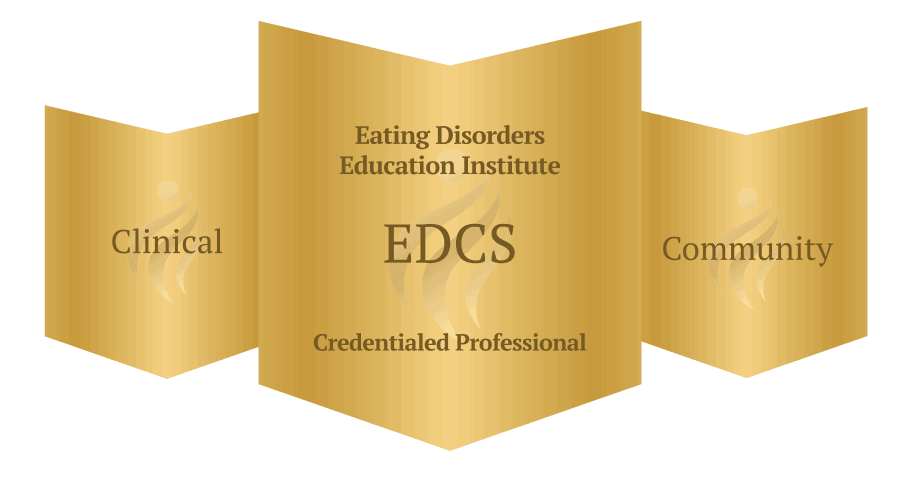
Choose your EDEI Learning Pathway to earn a full EDCS Professional Credential or one of our Certificates. EDEI provides recognizable, portable, uniquely verifiable virtual badges for each program.
How EDEI Prepares You as a Peer Support Specialist
Completing the EDEI Certification builds a specific set of core competencies: recognizing early warning signs of eating disorders, understanding the clinical and emotional landscape of recovery, and communicating with compassion across diverse populations. These aren’t abstract skills. They translate directly into how a Peer Support Specialist shows up for the people they’re supporting.
Confidence is a major part of this. Many people drawn to peer support work already carry deep empathy from their own experience, but may lack the structured knowledge to feel fully prepared. The EDEI Certification closes that gap, giving learners both the “why” behind eating disorder care and the practical tools to apply it.
Because the field of eating disorder treatment continues to evolve, the certification is also built with ongoing relevance in mind. The Eating Disorders Institute actively assesses where the field stands to ensure its courses reflect current best practices, not outdated assumptions.
Above all, the program is grounded in a humanistic, compassionate approach. The founders of EDEI designed the certification to reflect the kind of care they want to see in the field: one that treats both the person giving support and the person receiving it with dignity.
Getting Started with Your EDEI Certification
Enrolling in the EDEI Certification starts with choosing the path that fits your background, whether that’s as a clinical worker, a mental health professional, or someone from the general public interested in becoming a Peer Support Specialist. Courses are self-paced, so learners can move through the asynchronous material on their own schedule before joining the live practicum sessions.
Support doesn’t end at enrollment. EDI-trained practitioners lead the live group sessions, offering guidance and real-time feedback as learners apply their training. This structure is intended to make the certification journey feel supported from start to finish, not just another course to complete alone.
Trained Eating Disorder Peer Support Specialists Make Recovery More Possible
Eating disorder peer support, done well, saves people from feeling alone in one of the hardest experiences they’ll face. The EDEI Certification exists to make sure that support is both heartfelt and informed, rooted in lived experience and backed by evidence-based practice.
If you’re ready to turn your empathy and experience into structured, confident support for others, the EDEI Certification is a meaningful next step. Reach out to The Eating Disorders Institute to learn more about enrollment and find the certification path that fits your goals.
Frequently Asked Questions
Who can enroll in the EDEI Certification?
How long does the EDEI Certification take to complete?
Do I need prior experience to become a Peer Support Specialist through EDEI?
What makes the EDEI Certification different from other eating disorder trainings?
What happens if I already hold another eating disorder certification?
References
- Duvall, A., & Hanson, O. (2024). Peer support and beyond: The role of lived experience in a new era of eating disorder treatment. Focus, 22(3), 333–338. https://doi.org/10.1176/appi.focus.20240002
- National Institute of Mental Health. (2024). Eating disorders: What you need to know. National Institute of Mental Health. https://www.nimh.nih.gov/health/publications/eating-disorders
Hear From EDEI contemporaries
What I want to say to anybody who's entering this field is use your voice…because you never know the lives, the moments, the people, the memories that you're going to save by doing so.
EDEI is meaningful to me because it honors the stories, struggles, and resilience of everyone affected by eating disorders. Its education rooted in lived experience, evidence, wisdom and care.
When I first began developing “Foundations of Cultural Awareness and Sensitivity in Eating Disorder Practice, Research, and Advocacy,” my vision was…to cultivate an experience that opens doors for learners to reflect deeply, challenge assumptions, and grow into more culturally aware, sensitive, and responsive providers.
We all want to see our clients recover, and we must guide them in that direction taking into account their autonomy as well as our responsibilities as clinicians to protect.
about us
Sign Up For Information
Explore our website and learn more about how our courses can increase your knowledge, improve your care, and work toward a world that can better understand and treat eating disorders. EDEI delivers global learning, with courses that build knowledge and understanding, increase confidence, impact care.



12+ Courses Offered